
How Many Booked Calls Can LinkedIn outreach automation Really Deliver in 2026?
If you've ever Googled "LinkedIn outreach automation," you've probably landed on one of two extremes. Either breathless promises of "100 booked calls a month on autopilot!" or cynical "automation is dead" hot takes from someone who sent 500 copy-paste messages and got nowhere.
The truth sits somewhere more interesting — and more useful.
In 2026, LinkedIn outreach automation genuinely can fill your calendar with qualified sales calls. But the number of calls you'll actually book depends on a handful of variables that most people either ignore or get wrong. This article breaks down exactly what those variables are, what realistic benchmarks look like at each stage of the funnel, and how to set up your outreach so the numbers work in your favour.
Let's get specific.
The Funnel Behind Every Booked Call
Before we talk numbers, it helps to understand the chain of events between "start a campaign" and "qualified prospect in your diary."
Every booked call is the product of five stages:
- Reaching the right people — your ICP match rate
- Getting your connection request accepted — acceptance rate
- Starting a real conversation — reply rate
- Routing interested replies toward a meeting — conversion rate
- Showing up confirmed in your calendar — booking rate
Most people only think about step one (who to target) and completely neglect the rest. The magic — and the maths — lives in optimising all five together.
What Do the Numbers Actually Look Like?
Here are realistic benchmarks for each stage in 2026, based on well-run LinkedIn outreach automation campaigns:
Stage 1: ICP Match Rate
If you're pulling leads manually from Sales Navigator or relying on keyword searches, expect 40–60% of your list to be genuinely relevant. The rest are noise — wrong seniority, wrong industry, wrong moment.
With AI-powered targeting, that match rate climbs to 80%+. That matters enormously downstream. A higher match rate means better acceptance rates, better reply rates, and — crucially — better quality of conversations when they do start.
Stage 2: Connection Acceptance Rate
Industry average sits at 25–35% for cold outreach with a personalised note. Generic "I'd love to connect" requests are dropping closer to 15–20% as people get more selective.
Well-crafted, context-aware requests — ones that reference something specific about the person, their role, or their company — regularly hit 40–55%. That's not a marginal difference; it's the difference between 25 new connections from 100 requests vs. 50.
Stage 3: Reply Rate
This is where most automation falls apart. Template-heavy campaigns that blast the same message to everyone are seeing reply rates of 2–5% — and falling. LinkedIn users have developed an almost superhuman ability to spot a template.
Genuinely personalised follow-up sequences, where each message feels relevant to that specific person's situation, regularly deliver 8–15% reply rates. Some niches (high-value B2B, warm adjacent industries) see even higher.
Stage 4: Interested Reply to Booking Conversion
Of the people who reply positively — they're interested, they ask a question, they say "tell me more" — 30–50% will book a call if handled quickly and correctly.
The biggest conversion killer at this stage isn't the offer. It's speed. If someone expresses interest and doesn't hear back for 48 hours, they've moved on. The moment is gone. Automating the handoff (getting a booking link in front of a warm lead within minutes, not days) is one of the highest-leverage improvements you can make.
Stage 5: No-Show Rate
Not every booked call happens. Across industries, no-show rates for cold outreach meetings run at 15–30%. Confirmation reminders, particularly personalised ones sent the day before, bring this down to 10–15%.
Running the Maths: What Does a Good Month Look Like?
Let's put those benchmarks together and see what a well-run campaign actually produces.
Scenario A: Average setup (manual targeting, generic templates)
- 200 connection requests sent
- 35% acceptance = 70 new connections
- 4% reply rate = 8 interested replies
- 35% conversion to booking = 3 booked calls
Scenario B: Optimised setup (AI targeting, personalised messaging, fast reply handling)
- 200 connection requests sent
- 50% acceptance = 100 new connections
- 12% reply rate = 24 interested replies
- 45% conversion to booking = 11 booked calls
Same volume. Same platform. Roughly 3–4x more booked calls — just from doing the inputs properly.
Now scale that. At 500 requests per month with a well-optimised campaign, Scenario B produces 25–30 booked calls monthly. That's not a stretch goal. That's a realistic, achievable target when the whole funnel is working.
The Variables That Skew the Numbers (For Better or Worse)
Your ICP Specificity
The narrower and more precisely defined your ideal customer profile, the better every number downstream performs. A vague ICP ("marketing professionals at tech companies") produces bloated lists full of irrelevant contacts. A sharp ICP ("Head of Demand Generation at SaaS companies with 50–500 employees, raised Series A or B in the last 18 months") produces a smaller list that converts far better at every stage.
Understanding lead scoring is one of the fastest ways to tighten this up. When your outreach system knows exactly who to prioritise — based on firmographics, intent signals, and fit — your match rate goes up and your wasted time goes down.
Your Offer and Message Relevance
Even the best targeting falls apart if the opening message isn't relevant to what the prospect actually cares about right now. The most effective LinkedIn outreach automation in 2026 isn't just automated — it's contextual. Messages that reference the prospect's recent activity, company news, or specific pain points consistently outperform generic pitches by 3–5x on reply rate.
This is why AI-generated outreach that customises each message based on profile data outperforms any template library. A human couldn't write 200 personalised messages a day. AI can — and does.
Your Response Time to Warm Replies
We touched on this above, but it bears repeating because it's so commonly underestimated. Speed of follow-up is the single biggest conversion variable between "interested reply" and "booked call."
When someone says "yes, I'd like to know more" on a Tuesday afternoon and doesn't get a response until Thursday, the conversion rate crashes. When they get a friendly, personalised reply with a booking link within 10–15 minutes — even if that reply was triggered automatically — the conversion rate soars.
This is where hot lead detection changes the maths. Interested replies get caught in real time and a booking link lands while the prospect is still engaged. That one change alone can add 3–5 extra booked calls to your month without changing anything else.
Your Niche and Typical Deal Size
Not every booked call is worth the same. If your average client is worth £500/month, you need a lot of calls to justify your outreach investment. If your average client is worth £5,000/month, a single deal pays for months of outreach.
This is worth keeping in mind when you're setting expectations. Even a "slow" month with 8–10 booked calls — where 2 close — can mean £10,000+ in new ARR. The ROI on filling your calendar this way often runs at 10x or more against the cost of the tooling.
What 2026 Has Changed (And What Hasn't)
LinkedIn's algorithm and spam filters have got significantly smarter over the last two years. Volume without quality now gets accounts flagged faster than it used to. That's bad news for blast-and-pray automation — but it's good news for anyone running thoughtful, personalised outreach.
What's changed:
- Generic template messages are punished harder (lower deliverability, lower visibility)
- LinkedIn is better at detecting bot-like behaviour patterns
- Users are more discerning — the bar for what counts as a "good message" has risen
- AI-quality messages are now table stakes, not a differentiator on their own
What hasn't changed:
- People still respond to genuine, relevant conversations
- Decision-makers still book calls with people who seem to understand their problems
- The fundamentals of good outreach (relevance, timing, value, follow-through) still win
- Consistency still beats everything else — the biggest predictor of booked calls is simply showing up in people's inboxes regularly, not occasionally
Setting Realistic Targets for Your Business
Here's a simple framework for setting your own expectations:
- Define your ICP precisely — seniority, company size, industry, maybe a trigger event (funding, hiring, expansion)
- Estimate your addressable market — how many people fit that ICP on LinkedIn?
- Set a monthly outreach volume target — typically 300–600 connection requests for most campaigns
- Apply the optimised benchmarks — 45–55% acceptance, 10–15% reply rate, 40–50% booking conversion
- Work back to a realistic call target — then plan your sales process around it
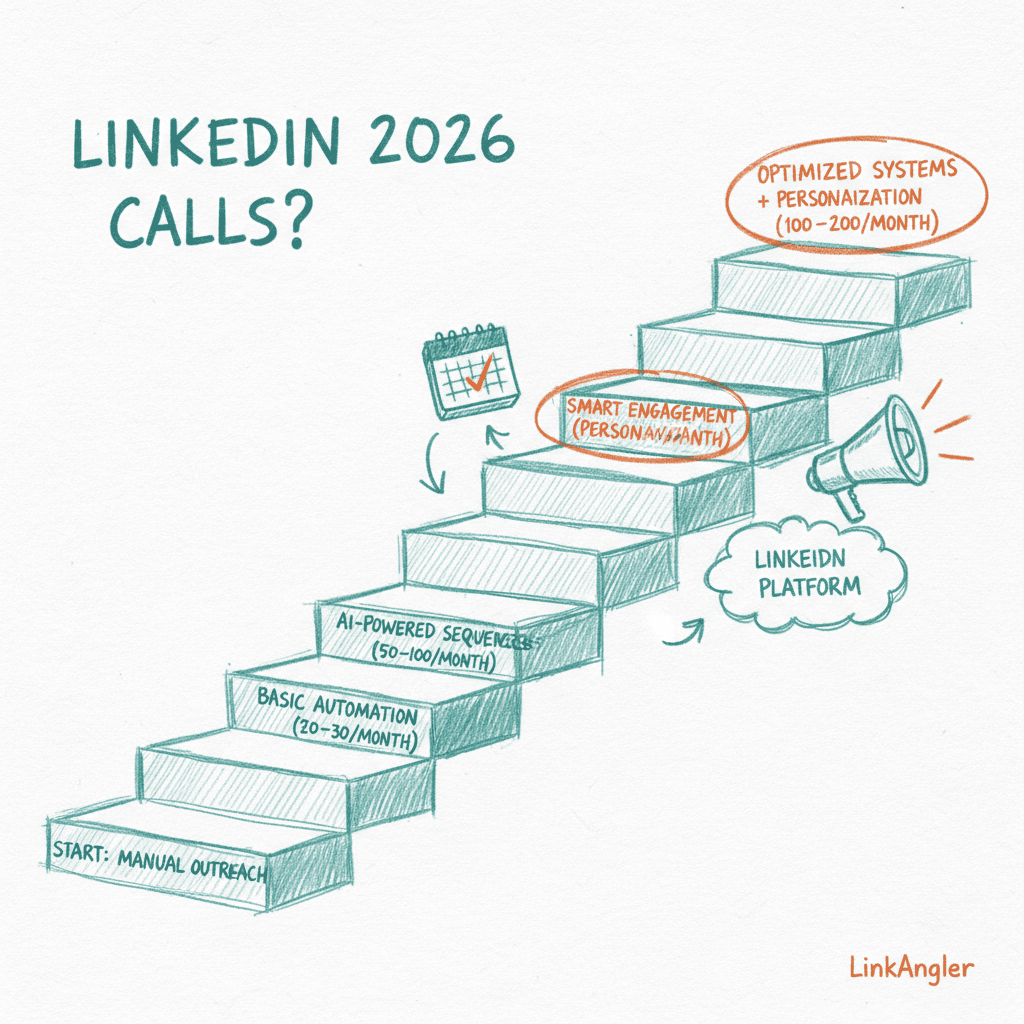
A small agency or solo founder running a focused campaign should realistically target 8–15 booked calls per month in the early stages, building to 20–30 as targeting and messaging are refined. A sales team running multiple campaigns through a platform like LinkAngler for sales teams can target significantly higher volume across multiple reps.
The Compounding Effect Nobody Talks About
Here's what the headline numbers miss: outreach gets better over time.
The first month of a campaign produces your baseline. By month three, you've learned what messages resonate, which ICPs convert best, and which objections come up most. By month six, you've got a machine that's been refined against hundreds of real interactions.
Campaigns that use self-optimising copy — where message performance data feeds back into improving future messages — compound faster. Lead rotation (re-engaging cold leads with a new angle rather than abandoning them) adds a second bite at prospects who weren't ready the first time.
The question "how many booked calls can LinkedIn outreach automation deliver?" has a short answer and a long answer. The short answer is: more than you're getting from manual outreach, with a fraction of the time. The long answer is: it depends on your ICP, your offer, your message quality, and how well your system handles warm replies — but the ceiling is genuinely high.
The Bottom Line
LinkedIn outreach automation in 2026 isn't a numbers game in the old sense. You can't just send more messages and expect more calls. The platforms, the users, and the technology have all moved on.
The new game is quality at scale — reaching exactly the right people, with messages that feel like they were written for them specifically, and handling interested replies fast enough that the moment doesn't slip.
Get those inputs right and the maths are compelling. Miss them and you'll be one of the people concluding that "automation doesn't work" — while someone in your market is booking 20 calls a month on autopilot.
See how LinkAngler puts this into practice — and what it looks like when your calendar starts filling itself.