
LinkAngler vs Dripify: Which LinkedIn Sales Automation Tool Wins?
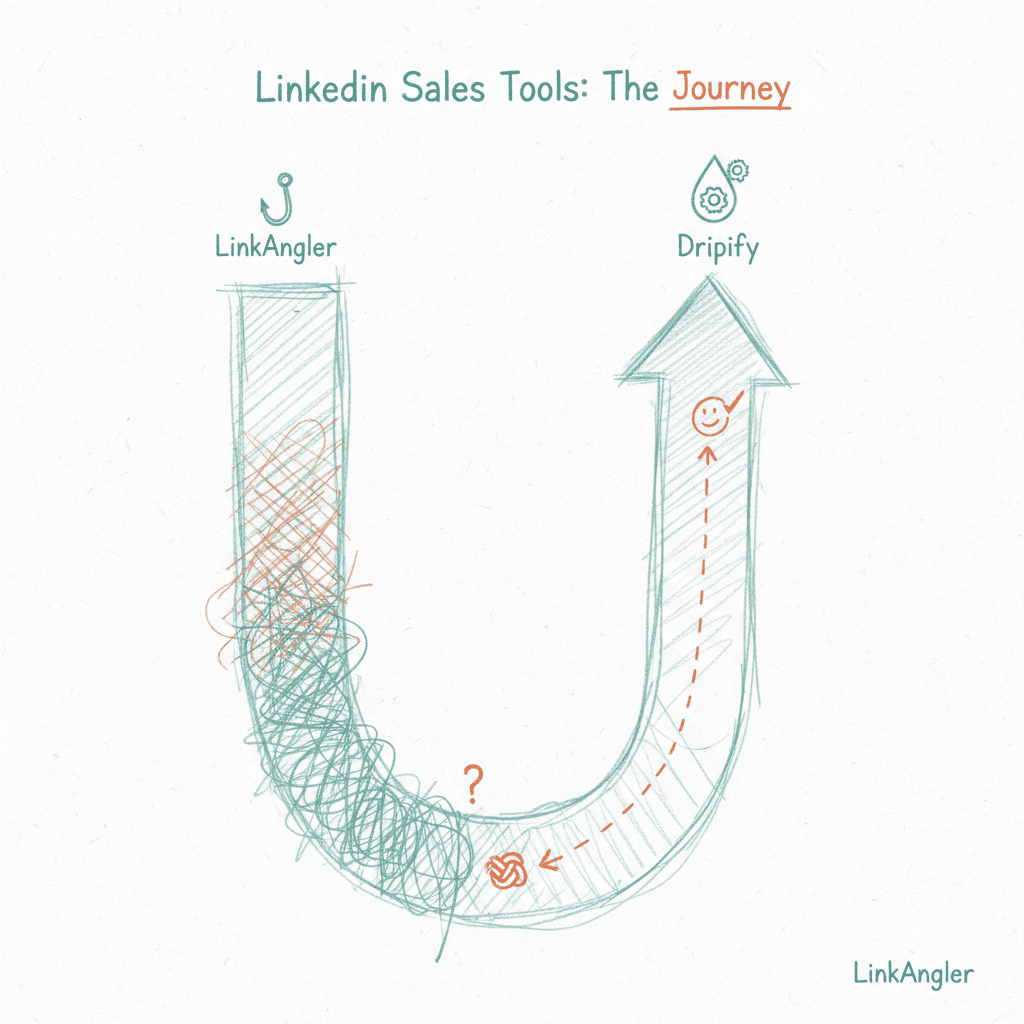
If you've spent any time researching LinkedIn sales automation, you've almost certainly come across Dripify. It's one of the more popular tools in the space, and for good reason — it's polished, reasonably priced, and covers the basics well.
But "covers the basics" is doing a lot of work in that sentence.
As LinkedIn outreach has evolved — from spray-and-pray connection requests to genuine, personalised, multi-channel engagement — the gap between tools that keep up and tools that don't has widened significantly. So if you're deciding between Dripify and LinkAngler, this breakdown will help you figure out which one actually fits where you're headed.
We'll look at both platforms honestly. Dripify does some things well. But there are also some meaningful gaps worth understanding before you commit.
What Dripify Actually Does Well
Let's be fair. Dripify has earned its reputation in the LinkedIn automation space. Here's where it genuinely delivers:
- Simple drip sequences — you can set up a basic connection → message → follow-up chain quickly without a steep learning curve
- A clean UI — Dripify's interface is approachable for people who aren't super technical
- Team features on higher tiers — you can manage multiple LinkedIn accounts from a single dashboard
- Basic analytics — acceptance rates, reply rates, and funnel views are all there
For someone who's brand new to LinkedIn sales automation and wants something that just works without a lot of configuration, Dripify is a reasonable starting point.
But "starting point" is the key phrase there.
Where Dripify Falls Short
Once you start pushing past the basics, the cracks start to show.
The Outreach Formats Are Pretty Limited
Dripify's sequences are fundamentally text-based. You can personalise messages with variables like first name, company, and job title — but that's table stakes in 2026. The days when a {{firstName}} in a LinkedIn message made someone feel special are long gone.
Buyers have seen it all. The best-performing outreach today uses formats that feel genuinely human — voice notes, personalised video, screen recordings. Dripify doesn't support any of these.
Lead Discovery Isn't Really Part of the Product
Dripify is primarily a sequence tool. You bring your own leads — typically by importing from LinkedIn Sales Navigator search results or a CSV. There's no built-in AI to help you figure out who is worth reaching out to in the first place.
That's a meaningful gap. Finding your ICP, scoring leads by fit, and prioritising the right people before you even start a campaign is half the battle in LinkedIn sales automation.
Engagement Features Are Shallow
Some of Dripify's plans include automatic profile views and post likes as part of a sequence, which is fine as a warm-up tactic. But there's nothing in terms of intelligent post engagement — where your AI persona comments meaningfully on a prospect's content before you reach out. That kind of "warm before you ask" activity genuinely moves the needle.
Artificial Usage Caps
Dripify applies daily limits and campaign restrictions that can feel frustrating if you're running a high-volume outreach operation or managing multiple clients. You bump into ceilings right when things start working.
How LinkAngler Approaches LinkedIn Sales Automation Differently
LinkAngler was built for teams that have graduated beyond basic drip sequences and want a full outreach engine — one where every step of the funnel, from finding the right person to getting them on a call, is handled inside a single platform.
Here's how the core features stack up against Dripify's approach:
AI Lead Discovery + ICP Scoring
Before you send a single message, LinkAngler helps you figure out who deserves your attention. The AI Lead Discovery feature surfaces prospects based on your ideal customer profile, and ICP Lead Scoring gives every lead a 0–100 score based on fit.
This matters because most outreach problems aren't sequencing problems — they're targeting problems. You could have the most beautifully written, perfectly timed message sequence and still get terrible results if you're talking to the wrong people.
With Dripify, you're on your own when it comes to list quality. With LinkAngler, the platform actively helps you build a better list before you ever start a campaign.
Multi-Step Campaign Automation (With No Artificial Ceilings)
LinkAngler's campaign automation supports multi-step sequences that include connection requests, messages, post engagement steps, and delays — similar to what Dripify offers, but without the usage restrictions that cap your volume.
If you're an agency running campaigns for multiple clients, or a sales team working high-volume prospecting, the ability to run without hitting artificial daily ceilings is genuinely valuable. You're only limited by what LinkedIn itself allows — not by a pricing tier decision your software vendor made.
Voice Note Outreach
This is one of the biggest differentiators between the two platforms.
LinkAngler supports AI-powered voice note outreach via ElevenLabs, including voice cloning. You record your voice once (or use a custom voice), write your message, and the platform generates a personalised audio message for each prospect.
Voice notes on LinkedIn have significantly higher open and reply rates than standard text messages because they feel personal. Recipients can hear a human voice. It bypasses the "this is a template" pattern recognition that causes most outreach to get ignored.
Dripify has no voice capability at all.
Personalised Video Outreach
Here's where the gap gets even wider.
LinkAngler's video messaging feature lets you record a single video and generate personalised, AI lip-synced variations for each prospect using fal.ai — so every recipient sees a video that appears to be addressed directly to them. You can also send personal webcam or screen recordings the old-fashioned way if you prefer.
From there, those videos can be hosted on a custom video landing page with auto-play, Open Graph previews for rich link appearance in LinkedIn messages, view tracking, and a booking CTA (Calendly, Cal.com, etc.) embedded directly on the page.
Think about what that sequence looks like from the recipient's perspective:
- They get a connection request
- They see a LinkedIn message with a rich video preview showing their name or company
- They click, watch a video that feels personalised to them
- They see a clear "Book a call" button right there on the page
That's a completely different experience than a text-based drip sequence, and it converts at a completely different rate.
AI Post Engagement
One often-overlooked part of effective LinkedIn sales automation is the "social warm-up" — engaging with a prospect's content before you reach out, so you're not a cold stranger when your connection request arrives.
LinkAngler automates this with AI-powered post engagement. You set up a persona, define the tone and style of engagement, and the platform leaves genuine, contextually relevant comments on your target prospects' posts. By the time your connection request lands, there's a reasonable chance they recognise your name from the comments section.
Dripify includes basic auto-like functionality as a warm-up step, but meaningful comment engagement isn't part of the picture.
BYO API Keys — No Markup on AI Usage
If you're using AI at scale — generating personalised voice notes, videos, or AI-written messages — costs can add up. LinkAngler lets you connect your own API keys for AI, voice, and video providers. You're not paying a platform markup on top of what ElevenLabs or fal.ai already charge. That's a meaningful difference for agencies or teams sending at volume.
Side-by-Side: How the Features Stack Up
| Feature | Dripify | LinkAngler | |---|---|---| | Multi-step sequences | ✅ | ✅ | | AI Lead Discovery | ❌ | ✅ | | ICP Scoring | ❌ | ✅ | | Voice Note Outreach | ❌ | ✅ | | Personalised Video Outreach | ❌ | ✅ | | Video Landing Pages | ❌ | ✅ | | AI Post Engagement | Basic (likes only) | ✅ Full comments | | No Artificial Usage Caps | ❌ | ✅ | | BYO API Keys | ❌ | ✅ | | Hot Lead Detection | ❌ | ✅ |
Who Should Use Which Tool?
Rather than just listing features, it's worth being honest about who each tool actually suits.
Dripify Is Probably Fine If…
- You're an individual contributor or small team just starting out with LinkedIn automation
- Your outreach is entirely text-based and you don't foresee that changing
- You want something with a short setup time and a shallow learning curve
- You have a well-defined lead list already and just need a sequencer to manage it
LinkAngler Is the Better Fit If…
- You're running LinkedIn sales automation at any meaningful scale — whether that's a sales team, a recruiting function, or an agency managing multiple clients
- You want to stand out in crowded inboxes using voice and video, not just text
- You need help finding the right leads, not just messaging them
- You're done leaving conversion on the table with generic outreach
- You want to run campaigns without constantly hitting artificial usage limits
If you're curious about how LinkAngler compares against other automation tools in the space, the comparison page goes deeper on specific feature and pricing differences.
The Practical Question: What Does This Mean for Your Results?
Let's say you're running a typical LinkedIn outreach campaign. You have a target list of 500 prospects. Here's roughly what the pipeline difference looks like:
With a standard text-based tool (Dripify style):
- Connection acceptance rate: ~25–35%
- Reply rate on messages: ~5–10%
- Meeting booked rate: ~1–3%
With a multi-format approach (voice + video + AI engagement):
- Connection acceptance rate: ~35–50%+ (warm-up engagement helps)
- Reply rate on messages: ~15–25%+ (voice and personalised video drive this)
- Meeting booked rate: ~5–10%+ (video landing pages with booking CTAs reduce friction)
These aren't numbers we've invented — they reflect what happens when outreach feels genuinely personal rather than obviously templated. And the format diversity that makes that possible simply isn't available in Dripify.
You can explore exactly how hot lead detection and campaign analytics work inside LinkAngler to see how these conversion improvements get tracked and optimised over time.
Making the Call
Both tools exist on the same spectrum of LinkedIn sales automation — they're just positioned at very different points on it.
Dripify occupies the "simple sequencer" part of the market. It does that job adequately. If that's all you need, it's fine.
But if you're serious about LinkedIn as a revenue channel — if you want to do more than fire off connection requests and hope for the best — then you need a platform that matches that ambition. One that helps you find the right people, reach them in formats that actually get noticed, and turn views into booked meetings without duct-taping together five different tools.
That's what LinkAngler was built for.
The outreach game has gotten harder. Inboxes are noisier. Buyers are more sceptical. The tools that win are the ones that help you feel less like a bot and more like a human — even at scale. Dripify isn't really built to do that. LinkAngler is.