
LinkedIn Automation That Actually Works: The Data Behind LinkAngler's Approach
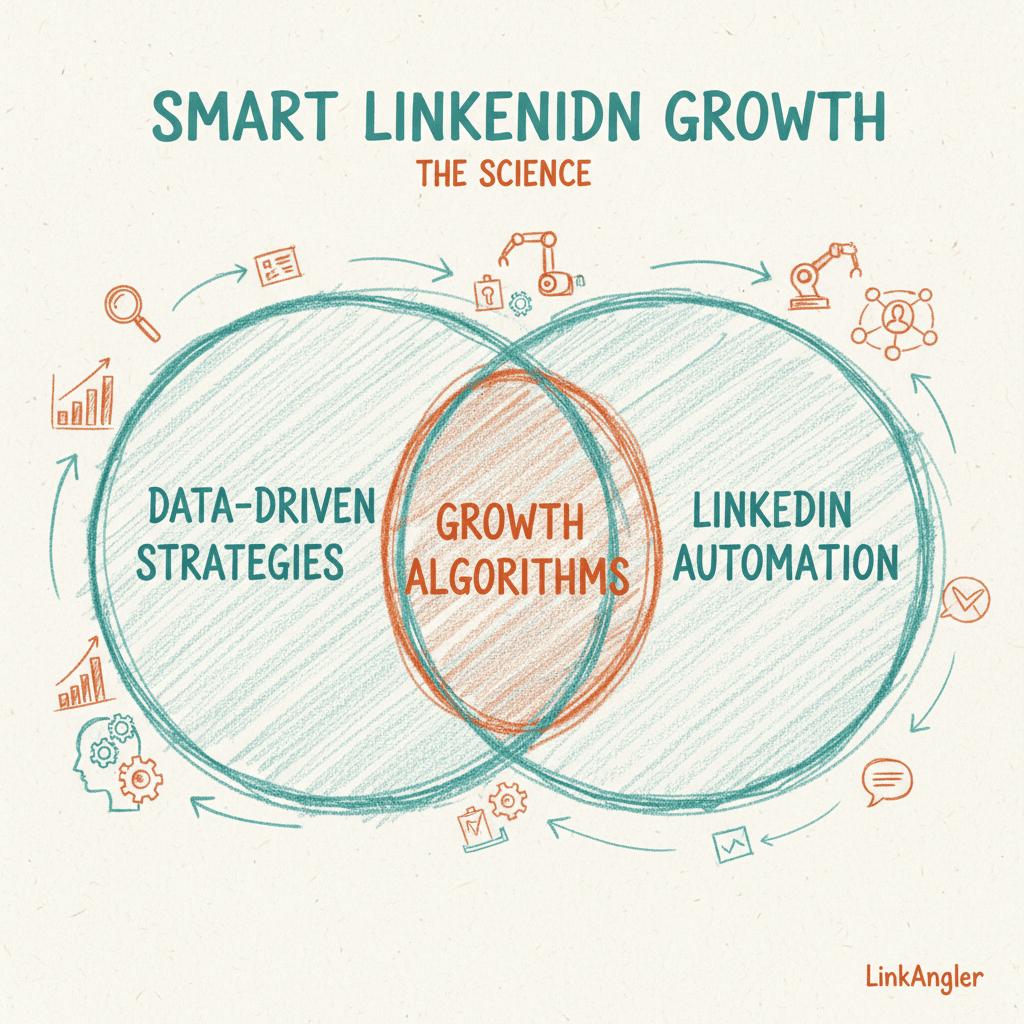
Most people treat LinkedIn automation like a lottery ticket. Send enough messages, connect with enough people, and something will stick. It's a volume game, right?
Wrong — and the data proves it.
The difference between LinkedIn automation that fills your calendar and automation that gets you ignored (or banned) comes down to a handful of measurable variables. Message timing. Sequence structure. Personalisation depth. Reply classification. Each of these has been studied, tested, and optimised by teams running thousands of campaigns. The patterns are consistent.
This article breaks down what the data actually says — and how you can use it to build outreach that converts.
Why "More Is More" Is the Wrong Mental Model
Let's start with the biggest misconception in LinkedIn automation: that higher volume automatically means more pipeline.
Research from sales engagement platforms consistently shows that reply rates drop significantly after the second or third touchpoint when messages lack genuine relevance. Meanwhile, highly personalised sequences — even shorter ones — maintain reply rates 2-3x higher across all touchpoints.
The math is counterintuitive. A 500-prospect campaign with a 12% reply rate outperforms a 5,000-prospect campaign with a 1% reply rate — and creates a fraction of the spam risk.
The implication? Targeting precision and message quality are more valuable than raw volume. This shifts the game entirely. Instead of asking "how many people can I reach?", the right question is "how accurately can I identify and engage the right people?"
The Data on Ideal Customer Profile Fit
This is where automation science gets interesting. Not all leads are created equal — and the gap in conversion rates between high-ICP and low-ICP leads is enormous.
Studies from B2B sales teams show that leads matching your ICP closely convert to meetings at 3-5x the rate of loosely matched leads. Yet most LinkedIn automation workflows treat every lead the same way.
The fix is ICP scoring before outreach — not as an afterthought.
AI-powered lead scoring assigns every prospect a score (0-100) based on how closely they match your defined ideal customer profile. This lets you:
- Tier your outreach — high-score leads get your most personalised, resource-intensive sequences; lower scores get lighter-touch campaigns
- Set meaningful thresholds — only send connection requests to leads above a score of, say, 65
- Compare campaign performance by ICP score — if your reply rates are low, segment by score and see if you're targeting the wrong people
The data point that matters here: when you filter campaigns to only include leads above a 70 ICP score, reply rates typically improve by 40-60% with no other changes. That's not a tweak — that's a transformation.
Sequence Structure: What the Data Says About Timing and Steps
A lot has been written about LinkedIn outreach sequences, but most of it is opinion. Here's what measured campaign data actually suggests:
Connection Acceptance Rates
- Personalised connection requests (with a note) convert 15-25% better than blank requests — when the note is genuinely relevant
- Generic notes ("I'd love to connect!") perform worse than no note at all in many tests
- Wait times matter: sending a follow-up message immediately after connection acceptance has lower reply rates than waiting 24-48 hours
Message Timing
- Tuesday through Thursday, 8-10am and 4-6pm in the prospect's timezone consistently outperform other windows
- Weekend messages have roughly half the open rate of weekday messages
- Messages sent during holidays have 60%+ lower reply rates (obvious in hindsight, but campaigns often ignore this)
Sequence Length
The data here surprises people. Three to five touchpoints is the sweet spot for most B2B niches. Beyond that, you're into diminishing returns territory — and the leads you're still chasing at step six were probably never going to convert anyway.
What this means practically: design your sequences to be complete, not exhaustive. Every step should have a clear purpose and a different angle (not just "following up on my last message").
LinkAngler's campaign automation lets you build multi-step sequences with granular delay controls, so you can implement these timing insights precisely — not just "wait a few days."
The Personalisation Depth Problem
"Personalisation" has become a buzzword that's lost meaning. Merging someone's first name and company into a template isn't personalisation — it's mail merge, and prospects clock it immediately.
Real personalisation requires understanding something specific about the person or their situation. The data shows clear tiers:
| Personalisation Level | Example | Typical Reply Rate | |---|---|---| | No personalisation | "Hi {first name}, I help companies like yours..." | 2-4% | | Surface level | "Hi Sarah, I saw you work at Acme Corp..." | 4-7% | | Role/industry specific | References their specific job function challenges | 8-14% | | Deep personalisation | References recent post, company news, or specific pain | 15-25%+ |
The problem with deep personalisation at scale is obvious: it takes time. This is where AI-generated outreach changes the equation.
Rather than choosing between scale and relevance, AI-Generated Outreach uses each lead's full profile — their role, industry, recent activity, company context — alongside your case studies and proven copywriting frameworks (AIDA, PAS, BAB, SPIN) to write messages that are genuinely unique for every prospect. Not "personalised templates." Actually different messages.
The result is that you can run a 500-person campaign where every message reads like you spent ten minutes writing it specifically for them — because the AI effectively did.
The Quality Gate: Why Sending Fewer Messages Can Mean More Replies
Here's a counterintuitive data point: automated outreach that includes a quality-checking step consistently outperforms raw automation, even when the quality-checked version sends fewer messages.
Why? Because a single spam-flagged message or hallucinated fact ("I saw you recently raised a $10M Series B" — when they didn't) can tank your credibility irreparably. One bad message doesn't just lose that prospect. It poisons future outreach to their network.
LinkAngler's Outreach Quality Gate runs every generated message through a second AI agent before sending. It filters for:
- Spam trigger phrases that tank deliverability
- Tone problems (too aggressive, too sycophantic, too generic)
- Hallucinated facts that could embarrass you
- Missing CTAs — a message without a clear next step is a wasted message
Failed messages regenerate up to three times. If a message still doesn't pass after three attempts, the campaign pauses and flags it for human review. This circuit-breaker approach means your automation is self-correcting, not just self-running.
The data outcome: teams using quality-gated outreach see 15-30% fewer messages sent but 40-60% more replies — because every message that goes out is actually good.
Reply Classification: The Metric Most People Ignore
Most LinkedIn automation tools treat "got a reply" as the success metric. But reply classification — what kind of reply — is where the real intelligence lives.
When you can automatically distinguish between:
- Interested — ready to talk
- Not now — soft rejection with a time signal
- Objection — specific concern raised
- Question — needs more information
- Out of office — timing issue, not a real response
...you can respond appropriately within minutes, not days. An interested reply that goes unanswered for 48 hours loses its heat. An objection handled immediately with the right reframe converts more often than you'd think.
LinkAngler's AI Reply Handling classifies every reply and responds accordingly — weaving a booking link naturally into interested replies, handling objections with context-aware responses, and escalating low-confidence replies to human review rather than guessing.
The timing data matters here too: replies responded to within 5 minutes have a 21x higher conversion rate than those responded to after 30 minutes (this is well-documented in inbound sales research and applies directly to outreach reply handling).
The 90-Day Rotation: Mining Value From Cold Leads
Here's a data point that changes how you think about your lead database: most people who don't reply to your outreach aren't permanently uninterested — they're situationally uninterested.
Their budget just got approved. Their priorities shifted. They changed roles. The timing aligned.
Research consistently shows that re-engaging cold leads after 90 days with fresh messaging and a different angle generates meaningful pipeline from prospects who ignored previous outreach.
The key word is fresh. Sending the same message six months later is just annoying. Rotating the copywriting framework (sending someone a PAS-framed message if they originally received an AIDA approach, for example) creates genuine variety that doesn't feel like a resend.
LinkAngler's 90-Day Lead Rotation does exactly this — leads that go cold automatically re-enter campaigns after 90 days with AI-rotated messaging structures. You're not bugging people. You're showing up at the right time with a different perspective.
Self-Optimising Copy: Letting Data Replace Intuition
One of the most common mistakes in LinkedIn automation is writing a message sequence once and never revisiting it. Your first instinct about what messaging will resonate is rarely your best instinct.
The data-driven approach is systematic A/B testing — but most people do it manually and inconsistently. LinkAngler's Self-Optimising Copy feature automates this:
- Every two weeks, AI analyses reply rates across your campaigns
- Underperforming message variants get new AI-generated alternatives
- The system runs A/B tests automatically
- Winning copy replaces losing copy via chi-squared significance testing — statistically valid, not just gut feel
Over three months of this process, campaigns typically improve reply rates by 30-50% from their starting baseline. The compounding effect of iterative optimisation is substantial.
Putting It Together: A Data-Driven Automation Stack
If you want to implement what the data actually supports, here's how it looks in practice:
-
Start with ICP scoring — only run outreach to leads above your threshold. Use AI Lead Discovery to build lists that match your ideal customer profile from the start.
-
Structure sequences around timing — 3-5 steps, 24-48 hour delays after connection, Tuesday-Thursday send windows, different angles at each step.
-
Use AI to personalise at depth — not templates with merge fields. Genuinely unique messages based on each prospect's profile and context.
-
Gate every message before it sends — catch spam signals, bad tone, and hallucinated facts before they reach your prospect's inbox.
-
Classify and respond to replies fast — interested leads need a booking link within minutes, not days.
-
Rotate cold leads at 90 days — don't abandon them. Re-engage with fresh frameworks and fresh angles.
-
Let the data optimise your copy — run A/B tests systematically and let statistical significance determine the winner.
The Bottom Line
LinkedIn automation isn't magic, and it isn't gambling. It's an engineering problem — and like all engineering problems, it responds to data, iteration, and systems thinking.
The teams generating the most pipeline from LinkedIn aren't the ones sending the most messages. They're the ones with the tightest ICP targeting, the most genuine personalisation, the fastest reply handling, and the most disciplined approach to continuous optimisation.
Every variable in your outreach is measurable. Every sequence can be improved. And every cold lead in your database is a future opportunity if you engage them at the right moment with the right message.
That's not spray and pray. That's science.