
personalised video prospecting in 2026: Why AI-Written Messages Outperform Templates
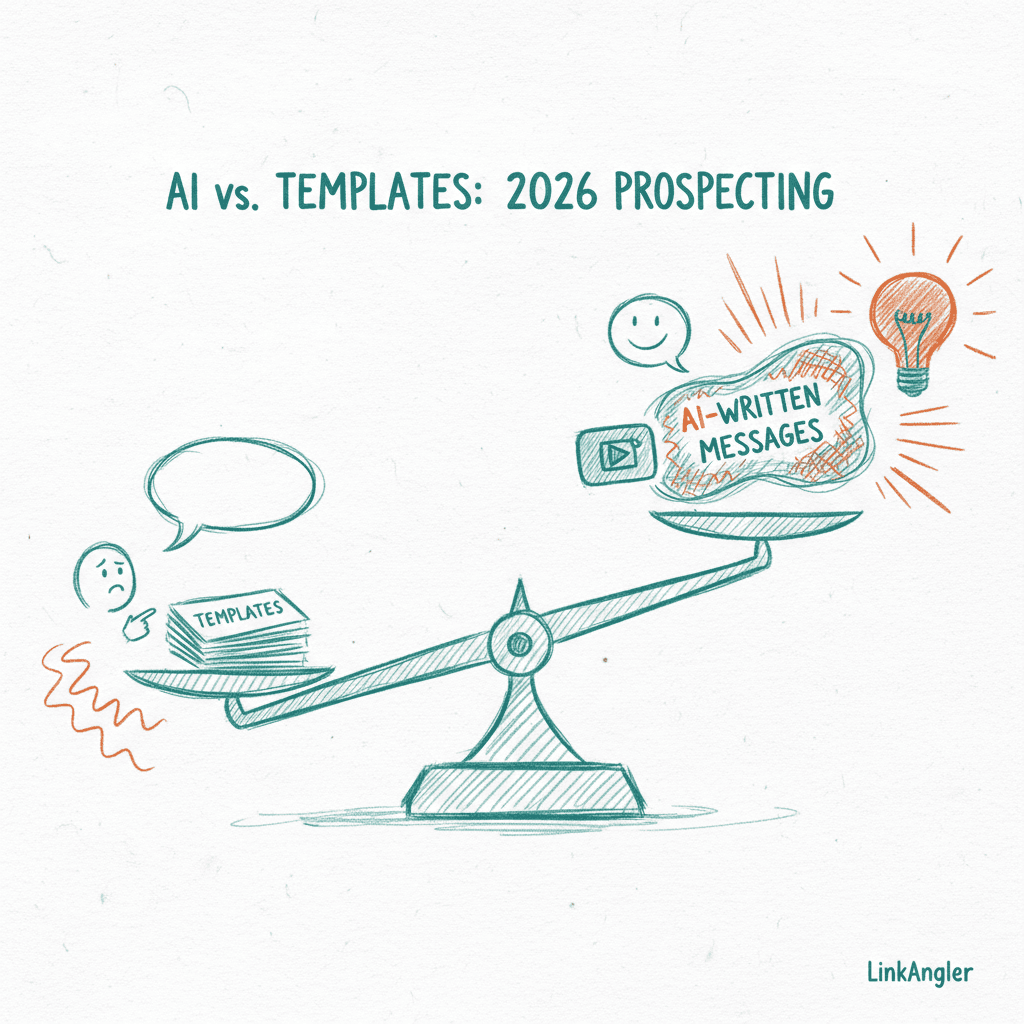
Let's be honest — you've received a templated LinkedIn message before. You know the ones. "Hi [First Name], I came across your profile and was impressed by your work at [Company]." The bracket didn't even get replaced. You closed it without replying, and you probably felt a little insulted that someone thought that would work on you.
Now flip it around. Your prospects feel exactly the same way when they receive yours.
Personalised video prospecting is one of the most effective ways to cut through that noise in 2026 — but only if the message surrounding it is equally personalised. That's where most people fall down. They slap a generic video on top of a template-based sequence and wonder why conversion rates are flat. The video grabs attention, sure. But the words around it — the connection request, the follow-up, the reply — that's where deals are won or lost.
This article breaks down why AI-generated, truly personalised messaging is outperforming templates at every stage, how video fits into that equation, and what a modern prospecting sequence actually looks like in 2026.
Why Templates Stopped Working (And When It Happened)
Templates were never great. But they were good enough when LinkedIn felt fresh and inboxes weren't flooded with automation-generated noise. That era is gone.
Here's what's changed:
- Volume has exploded. More teams are running LinkedIn outreach than ever before. The average decision-maker is getting 10–20+ cold messages a week.
- Buyers have learned to pattern-match. Humans are remarkable at spotting formulaic language. The moment someone reads "I help [job title]s at [company type]s achieve [vague outcome]", they're mentally checked out.
- LinkedIn's spam signals have gotten sharper. Low reply rates and high ignore rates reduce your SSI score and can suppress your account's reach.
The fundamental problem with templates isn't the concept of reusable structure — it's that templates optimise for the sender's efficiency, not the recipient's experience. They flatten the message to the lowest common denominator across your entire prospect list.
What "Personalised" Actually Means in 2026
There's a spectrum here, and it's worth being precise.
Level 1: Variable substitution
Inserting {first_name} and {company} into a fixed template. This is table stakes and everyone knows it. It feels personal but isn't.
Level 2: Research-based manual personalisation
A rep reads each prospect's profile, recent posts, company news, and writes something genuinely specific. High quality, but completely unscalable. You might manage 10–15 of these per day.
Level 3: AI-generated contextual personalisation
AI pulls from the prospect's profile, job title, company, recent activity, and your ICP scoring data to write a message that's structurally unique — not a filled-in template — for each individual. Different framing, different hook, different angle, every single time.
This is where the industry has landed in 2026. The best outreach at scale uses AI to operate at Level 3 quality without the Level 2 time cost.
LinkAngler's AI-generated outreach does exactly this — pulling from lead profiles, case studies, and proven copywriting frameworks (AIDA, PAS, BAB, SPIN) to write messages that are genuinely different for each prospect. Not variations on a theme. Actually different messages with different structures depending on what's most relevant to that person.
Where Personalised Video Prospecting Fits In
Video has a clear role: it creates a pattern interrupt. Text-only messages, however well-written, blend into the inbox. A thumbnail of your face — or better, a personalised video with the prospect's name or LinkedIn profile visible in the shot — forces a second look.
But here's the thing most people get wrong: video is not a substitute for message quality. It's an amplifier. A bad message in video format is still a bad message. A great message with a video attached is exponentially more powerful.
The ideal sequence for personalised video prospecting in 2026 looks something like this:
- Connection request — short, genuine, not salesy. AI-written based on a shared connection, mutual interest, or specific observation about their work.
- First message post-connection — introduces context, leads with value, no hard pitch. Again, AI-written and unique to that prospect.
- Video message — a personalised video that references something specific (their recent post, a challenge relevant to their role, your shared context). This is your pattern interrupt and your credibility builder.
- Follow-up — references the video, handles likely objections, includes a soft CTA.
- Final touchpoint — clean, low-pressure close with a booking link.
This is a multi-step sequence where every element is doing a specific job. The video is step three — not step one — because you need a little context and familiarity before someone will press play on a video from someone they don't know.
The Problem With Template-Based Video Outreach
A lot of teams have adopted video prospecting in some form. Many of them are still wrapping those videos in template-based text. Here's why that undermines the entire effort:
Cognitive dissonance kills trust. When someone receives a video that feels genuinely personalised but the surrounding copy reads like a broadcast message, it creates a jarring inconsistency. The prospect senses it, even if they can't articulate why.
Templates can't respond to context. If a prospect posted something interesting on LinkedIn last Tuesday, a template won't reference it. AI can — and it should, because that context is exactly what makes a message land.
Template fatigue is accelerating. As video prospecting has gone mainstream, the same template videos are circulating. The "I recorded this just for you" opener that worked in 2022 now triggers immediate scepticism.
The solution isn't to stop using templates entirely — it's to stop treating templates as finished messages. Use copywriting frameworks as structural guides, but let AI generate the actual content within that structure for each individual prospect.
How AI Writing + Video Creates a Multiplier Effect
When AI-generated copy and personalised video work together, something interesting happens to your conversion funnel.
Think about it in terms of attention and trust:
- Video captures attention — it gets the open, the hover, the pause
- AI-written copy builds trust — it demonstrates that you've actually looked at this person and have something relevant to say
Neither works as well alone. Generic video + generic copy = slightly better than plain text, but not by much. Specific video + specific copy = a prospect who feels genuinely seen, which is the emotional trigger for reply behaviour.
For teams doing personalised video prospecting at scale, AI-powered video messages like those in LinkAngler (using fal.ai for lip-synced video variations and webcam recordings with personalised video landing pages) mean you can record one video and generate contextually varied versions without spending hours in front of a camera. Pair that with AI-written copy that's unique to each recipient, and you've got a genuinely differentiated outreach stack.
The Quality Problem Nobody Talks About
Here's a practical challenge with AI-generated outreach that most tools don't address: AI hallucinates. It sometimes invents facts, misses context, or generates messages with subtle tone problems that would embarrass you if sent.
This is a real concern — but it's solvable. The answer isn't to go back to templates (which have their own quality problems); it's to build a quality gate into the process.
LinkAngler does this with an Outreach Quality Gate — a second AI agent that reviews every generated message before it goes out, checking for spam triggers, hallucinated facts, missing CTAs, and tone issues. Messages that fail auto-regenerate (up to three times). If a campaign hits three consecutive failures, it pauses automatically so you can review what's happening.
This is the kind of infrastructure that separates serious outreach tooling from toys. See the full feature set here.
Building a Personalised Video Prospecting Sequence That Actually Converts
Let's get practical. Here's a blueprint you can work from:
Step 1: Define your ICP precisely before you build anything
Garbage in, garbage out. AI-generated personalisation is only as good as the lead data feeding it. Use ICP lead scoring to prioritise your list before you invest time in video creation. Focus your highest-effort personalisation on your highest-scored leads.
Step 2: Segment your list by context clusters
Group prospects by shared attributes that create natural personalisation angles:
- Same industry / vertical
- Same job title progression
- Recent company news (funding, new product launch, hiring surge)
- Recent LinkedIn activity (post engagement, comments)
Each cluster becomes a slightly different campaign with different messaging angles — even if the AI is writing each message individually.
Step 3: Record your base video(s) strategically
For personalised video prospecting at scale, you don't need a unique recording for every single prospect. Record 2–3 strong base videos that map to your segments, and let AI-powered personalisation handle the variation. The key is to keep base videos short (60–90 seconds max), conversational, and specific enough to feel relevant without being so narrow they only work for one person.
Step 4: Build landing pages, not just video links
Don't send video files. Send video landing pages with auto-play, your prospect's context visible, and a clear booking CTA embedded (Calendly, Cal.com). This increases view completion, makes tracking possible, and creates a more professional experience. It also lets you know who watched, for how long, so you can prioritise follow-ups intelligently.
Step 5: Let AI handle the reply layer
The hardest part of any outreach sequence is what happens after someone replies. Busy reps drop follow-ups. Slow replies kill warm leads. AI reply handling — where interested replies automatically get a booking link woven into a contextual response — means warm leads don't go cold while you're in a meeting.
The Metrics That Tell You If It's Working
If you're running personalised video prospecting sequences, here's what to watch:
- Video open/view rate — if under 40%, your subject line or preview thumbnail needs work
- Video completion rate — if people are dropping off in the first 20 seconds, the hook isn't landing
- Reply rate per message step — which touchpoint in your sequence is generating replies? Double down on that format
- Positive reply rate — not just total replies, but how many are genuinely interested vs. "remove me"
- Meeting booked rate — ultimate measure of whether the sequence is converting
A well-built AI + video sequence should see reply rates in the 15–30% range for a warm, well-targeted list. Template-based sequences on the same list typically hover in the 3–8% range. The gap is real, and it compounds across a full pipeline.
Wrapping Up
Personalised video prospecting in 2026 isn't a gimmick — it's a legitimate competitive advantage for teams that do it properly. But video alone isn't the differentiator. The difference is combining video with genuinely personalised, AI-generated copy that makes each prospect feel like you've actually thought about them specifically.
Templates had their moment. That moment is over. The teams winning deals now are using AI to operate at a level of personalisation that was previously only possible with a dedicated researcher and copywriter behind every message.
If you want to see how a full campaign automation stack with AI writing, video messages, quality gates, and reply handling fits together, it's worth taking a look at what modern outreach infrastructure actually looks like.
The bar has moved. The good news is — so has the tooling.